Product Overview:
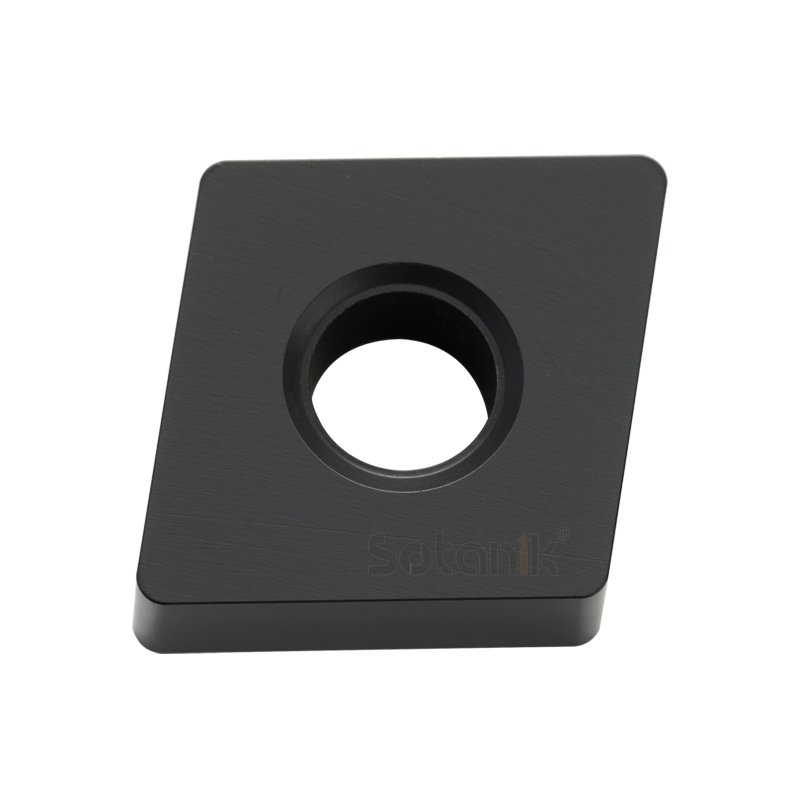
CNMA turning insert tips feature an 80-degree rhombic negative profile with a flat top rake on micro-grain carbide. In addition, Grade HM3115 applies a thick CVD multi-layer coating to resist abrasive flank wear from hard graphite particles. As a result, this CNMA insert cuts grey iron and ductile iron without edge chipping under interrupted turning passes. Therefore, CNC lathe machinists select this carbide turning insert to stabilize tool life on heavy casting components.
Product Features:
First, the CNMA turning insert incorporates a double-sided negative design with two usable 80-degree cutting corners per face, totaling four sharp cutting edges. In addition, the tough carbide core pairs with an alpha-alumina CVD thermal barrier layer to withstand cutting temperatures up to 1000°C. By contrast with chipbreaker tips, this flat-top CNMA carbide insert provides rigid edge support against heavy casting scale. Consequently, operators push high depths of cut without experiencing premature edge fracturing.
Application and Machining Materials:
Specifically, workshops deploy CNMA120404, CNMA120408, and CNMA120412 corner radii across CNC turning centers and vertical turret lathes. In addition, this grade cuts ASTM Class 35 grey iron, 65-45-12 ductile iron, and compacted graphite iron reliably. Therefore, manufacturing engineers specify this indexable turning insert for automotive brake discs, diesel engine flywheels, water pump housings, and agricultural machinery hubs running at feed rates up to 0.35 mm/rev/
Specification of CNMA Carbide Turning Insert

| Model | L | IC | S | d | R |
| CNMA120404 | 12.9 | 12.7 | 4.76 | 5.16 | 0.4 |
| CNMA120408 | 12.9 | 12.7 | 4.76 | 5.16 | 0.8 |
| CNMA120412 | 12.9 | 12.7 | 4.76 | 5.16 | 1.2 |
| CNMA160608 | 16.1 | 15.875 | 6.35 | 6.35 | 0.8 |
| CNMA160612 | 16.1 | 15.875 | 6.35 | 6.35 | 1.2 |
| CNMA160616 | 16.1 | 15.875 | 6.35 | 6.35 | 1.6 |
| CNMA190608 | 19.3 | 19.05 | 6.35 | 7.94 | 0.8 |
| CNMA190612 | 19.3 | 19.05 | 6.35 | 7.94 | 1.2 |
| CNMA190612 | 19.3 | 19.05 | 6.35 | 7.94 | 1.6 |
FAQs:
1. Why does this flat-face CNMA cast iron insert outperform chipbreaker inserts in casting turning?
Specifically, cast iron fractures into tiny discontinuous chips rather than long strings, which eliminates the requirement for curly chipbreakers. In addition, the solid land on this CNMA cast iron insert provides rigid wedge support right behind the cutting edge. Therefore, machine shops choose this geometry to absorb abrasive sand inclusions without fracturing the tip.
2. How does the 80 degree rhombic insert shape balance profile versatility and cutting edge strength?
First, this 80 degree rhombic insert combines an acute angle for axial profiling with a wide cross-section for heavy facing passes. In addition, the rigid diamond layout allows turning tools to transition between OD roughing and end-face squaring in one continuous path. Consequently, machinists deploy this cast iron turning insert to simplify CNC tooling setups.
3. How does Grade HM3115 CVD coating suppress abrasive wear during dry iron turning?
First, Grade HM3115 applies a thick multi-layer CVD coating featuring a dense aluminum oxide layer. In addition, this crystalline coating acts as a thermal barrier that blocks heat transfer into the substrate during dry cast iron machining insert passes. Therefore, machine operators double their cutting speeds on a CNC turning insert without accelerating crater wear.
4. When should operators select CNMA120404, CNMA120408, or CNMA120412 corner radius?
Specifically, choose CNMA120404 with a 0.4 mm radius to prevent deflection chatter on thin-walled cast sleeves. In addition, deploy CNMA120408 for balanced general-purpose roughing and finishing. Finally, select CNMA120412 with a heavy 1.2 mm radius for severe interrupted roughing on rough casting scale. Therefore, machinists match insert nose radii directly to required surface finish tolerances.
5. How many usable cutting edges does this negative turning insert provide?
Specifically, this 80-degree diamond negative turning insert features two usable 80-degree nose corners on each planar face. In addition, operators simply flip and index each indexable turning insert to access the opposing side, which delivers four durable cutting edges per tip. As a result, machine shops cut tooling expenses in half on continuous casting runs.



Reviews
There are no reviews yet.